
By MTBSA contributor
Jul 6, 2026
The lines between bike categories are constantly blurring. Lately, long-travel, aluminium freeride bikes have been on the rise, be it enduro, downhill, or park bikes.
Before we get any further, let’s define what a “park bike” is. Park bikes come in various forms, from short travel, like the Zink Vacay, to the cushy Devinci Chainsaw. They focus on hitting jumps and features with confidence, whereas enduro and downhill are tailored to their specific forms of racing. That’s not to say that a custom-built version of an enduro or downhill bike couldn’t be reshaped into park bikes, but it will take some component modification, like a smaller rear wheel, or possibly making the head tube angle steeper. In fact, some variants of the bikes mentioned are available from the factories in those forms.
Throwdown Details
• 170mm travel, 170mm fork
• Wheel size: 29" front, 27.5" (mixed)
• Aluminium frame
• Dual-crown compatible
• 63.5° head tube angle
• 435mm chainstays (S-M/L), 442mm (L, XL)
• Sizes: S, M, M/L (tested), L, XL
• Weight: 17.5 kg / 38.5 lb (measured, M/L w/Eagle 90 build)
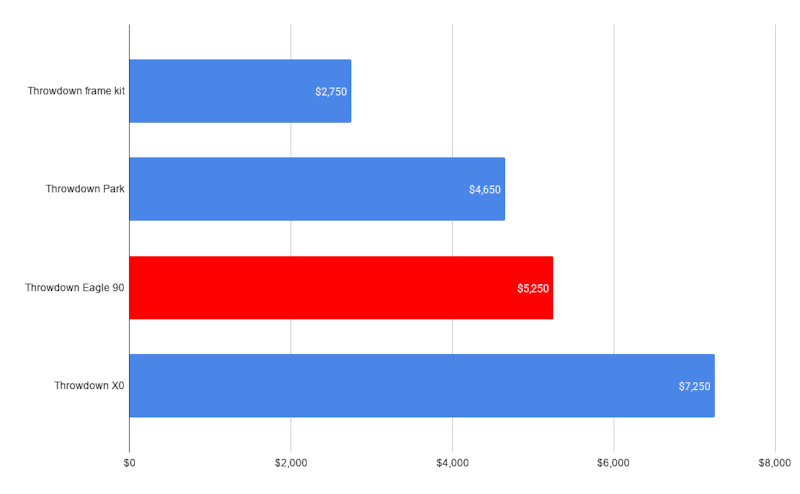
• Price: $5,250 USD / $6,950 CAD (as tested)
• Frame only: $2,750 USD / $3,450 CAD
• chromagbikes.com
The Chromag Throwdown enters the game with a big, honking frame with 170mm of travel front and rear that’s built Whistler-tough. It’s essentially a choppered-out enduro bike capable of handling lapping the bike park all day long. At the same time, the Throwdown can still pedal to those secret stashes which a downhill bike would have a tougher time accessing
| If you regularly ride a chairlift or shuttle, but love the simplicity of one bike, then the Chromag Throwdown is a quality choice. The comfort of the suspension and sturdy frame gives the calmness of a downhill bike without killing the buzz on jump trails. It wouldn't be my first choice as a do-it-all enduro bike - there are more well-rounded choices out there, but it can get the job done, just at a slower pace uphill. With that said, the parts on the Eagle 90 build make it a worthy contender for anyone seeking out this type of niche bike.— MTBSA contributor
Frame Details
If you’re familiar with Chromag’s full suspension bikes, you’ll recognise the Throwdown from a mile away with the huge rocker link and prominent head tube badge. It’s not a light frame to begin with. The Throwdown frame moves the needle to 4.5 kg (9.9 lb (4.5 kg)) for a M/L, a few hundred grams more than the Raaw Madonna R, and like that bike, the bearings and hardware never missed a beat throughout the review.
As I mentioned in the First Ride, the Throwdown is the first adult-size bike from the Whistler-based company to use an aluminium front triangle. The features follow Chromag’s no-B.S. ethos. That means external cable routing from top to bottom, water bottle bosses for supplies, and zero adjustment points - minimal faff, as they say. On that note, the rear wheel size is limited to a 27.5”.
Two areas that could use refinement are the cable clamping zone behind the head tube gusset and the short gap along the chainstay protector. Otherwise, the chainslap protector does an incredible job of taming noises, even over the worst braking bumps.
Suspension Design
Following suit with the frame’s functionality is the four-bar, Horst-link suspension layout. Chromag’s choice of pivot points gives a very supple, cushioned ride that has no irregularities. The result is a predictable, comfortable ride in all trail scenarios.
When it comes to pedalling performance, the Throwdown behaves as you’d expect for a long-travel park weapon. There’s some bob when sprinting, but it holds fairly still when buckled in on long road climbs.
Chromag specifies the Vivid air shock on the Throwdown, however, a coil shock is said to pair nicely too. Huge impacts are softened by the Vivid and its adjustable hydraulic bottom-out (ABO) feature. I found the tune to match decently well, but looked for additional support once I learned how the Throwdown handles and speeds increased (more on that later).
Geometry
I was stoked to see that Chromag didn’t shortchange riders when it came to finding their ideal size. They make all of their full-suspension frames in five sizes, from size Small, all the way up to XL, including the seldom seen M/L. It’s worth noting that Chromag’s sizing may be larger or have a longer reach number than you’re used to.
I’ll talk a lot about the balance of the Throwdown because that’s what separates it from the Lowdown, Chromag’s enduro bike. Both bikes have slack head tube angles and long reach numbers for their frame size labels, though the Lowdown is a smidge longer (490mm).
It’s the same story at the back of the bike. The Throwdown chainstay is 435mm (442mm on the L and XL frames), 5mm shorter than the Lowdown. The drop-down to a smaller wheel size compounds the effect of the short, snappy rear end.
On the geometry chart, the head tube angle reads 63.5, but it seems slacker on the trail. Everything checked out when I measured the head tube angle using an iPhone angle finder (however precise that may be).
Specifications
Specifications
Release Date | 2026 |
Price | $5250 |
Travel | 170 |
Rear Shock | RockShox Vivid Ultimate |
Fork | RockShox Zeb Select+, 170mm, 44mm offset |
Headset | Cane Creek 40 ZS44/ZS56 |
Cassette | SRAM Eagle 90 Transmission |
Crankarms | SRAM 90 Transmission 165mm, 30-tooth ring |
Bottom Bracket | SRAM DUB BSA |
Rear Derailleur | SRAM Eagle 90 Transmission |
Chain | SRAM GX Eagle 90 12 Speed T-Type |
Shifter Pods | SRAM Eagle 90 Transmission |
Handlebar | Chromag OSX 35, 25mm rise |
Stem | Chromag HiFi BSX 35, 35mm length |
Grips | Chromag Format |
Brakes | SRAM Maven B1 Bronze w/Centerline rotors 200mm F&R |
Wheelset | Chromag BA30 V2 w/R6 hubs |
Tyres | Maxxis DHF 29x2.5" DD, Maxx Grip (f)/DHR II 27.5x2.4" DD, Maxx Grip (r) |
Seat | Chromag Trailmaster |
Seatpost | OneUp V3, S 150mm; M 180mm; M/L 210mm; L 210mm; XL 240mm |
Test Bike Setup
Chromag’s sizing chart places me (178cm) smack dab in the middle of the elusive M/L frame. At 485mm, the reach is on the upper limit of what I can ride; however, once I placed 20mm of spacers under the stem, the cockpit felt more within reason.
I followed Chromag’s suspension setup guide, and found the air pressures for my weight (78kg) to be on the softer, plusher side. I found that the rear shock rode better when inflated to read 27% sag, while the fork remained at 14% sag. After fiddling with the air pressure and ABO feature on the Vivid, I added a third volume spacer to the air can. That provided the resistance I needed as the shock neared full travel.
In the saddle zone, I switched out a few components. The M/L review bike came with a 180mm dropper post, which usually fits me well, but additional clearance was needed, so I installed a 210mm dropper. Chromag did state that it's possible to contact their customer service team when ordering a bike and request this change.
MTBSA contributor
Location: Squamish, BC, Canada
Age: 39
Height: 5'10" / 178 cm
Weight: 170 lb (77.1 kg) / 78 kg
Industry affiliations/sponsors: None
Instagram: @mattb33r
I also added an Aenomaly SwitchGrade, which some keen-eyed readers picked up on in the First Ride article. I found that the sheer size of the Trailmaster saddle could get in the way of the Throwdown's descending and jumping purposes.
Testing Info:
During most of my rides on the Throwdown, I set out with the intent to hit the steepest trails or tackle serious features. Although I didn't cover the exact route on the map below with the Throwdown, the trails listed encompass the terrain I did ride regularly. These are where Throwdown thrives - places that you want a downhill bike on the descents, but couldn't be bothered pushing one up to the entrance.
Climbing
I’ll kick off the climbing chat by stating that the Throwdown climbs as expected for a monster truck. I didn’t expect it to breeze uphill at a blistering pace. Sticky tyres and a hefty weight of 17.5 kg (38.6 lb (17.5 kg)) mean a slow and steady approach on road climbs.
One way to make the most of the uphill performance in a bike of this nature is to prop it up for the rider with a steep seat tube angle, which the Throwdown has. 78-degrees drives your legs straight down onto the cranks, rather than slouching off the back of the saddle.
The seat tube angle is a big win for this bike, as the short chainstays have a tendency to wheelie when trying to winch up small punches. The 27.5” rear wheel doesn’t help either. It has a tendency to hand up easier than 29er and doesn’t offer as much traction.
Climbing becomes more tedious when the trail tightens up. As I pointed out earlier, the head tube angle seems slacker than stated, and that calls for strong arms and core strength to keep the front wheel on track up sharp switchback corners.
Big travel helps out in the traction department as the suspension glues itself to the ground. A+ there. It doesn’t bob too much for a 170mm travel bike, but the ground clearance is low. I had a hard time cleaning climbs that I can tackle on other bikes of this stature.
I’m really kicking the Throwdown when it comes to climbing, because it’s certainly not its forté. I’d rank it down next to other big-travel enduro bikes, like the Devinci Chainsaw and Norco Range. Luckily, each of those bikes absolutely mows rocks when it's time to turn around and head down.
Descending
Right, time for the fun stuff, going downhill. A lot of enduro bikes get overwhelmed when faced with the speed and impacts of a bike park. Sometimes they rattle you to death, or the braking bumps eat them alive. Not on the Throwdown, though. The comfort and confidence to charge in the nastiest pinball sections rival most downhill bikes.
Bump absorption is the Throwdown’s finest factor. I found a similar characteristic with the Reazon, Chromag’s 135mm travel steel trail bike. But this struck me as a surprise - I didn’t expect that quality to be reflected in the Throwdown’s aluminium frame. There’s very little bump or chain feedback transmitted through the rider’s feet. In fact, I’d argue that flat pedal riders could have an easier time keeping their feet attached because of that.
I found the rear suspension had a tendency to ride deep and tag the bottom often. Ramping up air pressure, increasing the air spring progression, and closing low-speed compression tamed that habit. It helped even out the support and balance on flatter trails. Otherwise, it’s far too easy to fall behind the rear wheel and fold the rear tyre in a corner.
Even with those changes, the handling of the Throwdown can be funky on mellow tracks. You’ll want to exaggerate how much you place on the bars, or potentially face sliding the front tyre. The same goes on jump lines, like Dirt Merchant, for example. It borders on too slack to ride up steep lips and tuck the long wheelbase into short landings. That said, specific landing zones aren’t always needed on a bike with this much cushion.
All of that makes it ironic for Chromag to call the Throwdown a park bike, because I’d peg it as more of a freeride bike: the faster and gnarlier, the more confidence and control you have. Think of plunging down chundery chutes, death gripping berms full of holes, or lining up the steepest slabs. It’s the type of bike that is capable of huge features. It saved my ass more than once.
What's the Best Value?
There are four ways to purchase a Throwdown: two enduro builds, one pure gravity kit, or a frame only. The last option offers moderate value too, but I have a tough time believing you could match the price tag on the Eagle 90 component spread. The “Park” build, as Chromag calls it, with its dual-crown fork and narrow-range drivetrain, comes in at a reasonable price, but appeals to a very specific type of rider. It's not quite a downhill bike, yet you likely won't be travelling uphill much unless you're walking.
For those reasons, I'd award the best value to one of the uphill-friendly versions: the Eagle 90 build. This delivers everything you need in a hard-charging 170mm-travelbike, without the extra fluff. It's stocked with strong brakes, tough wheels, and stellar suspension.
Performance-wise, the components give you the versatility of an enduro bike with RockShox’s cushiest suspension features. ABO is found at both ends, though the mechanisms operate in separate ways. The Vivid delivers a hydraulic bump-stop, while the Zeb Select+ gives you the elastomer bottom-out control. Plus, you can do X-ups with a single crown fork.
Shifting duties are carried out by a SRAM 90 T-type derailleur without the hassle of charging batteries. In the braking department, SRAM Maven Bronze brakes have been highly rated by all of MTBSA’s editors. Those could be beefed up with larger, thicker rotors if needed.
How Does It Compare?
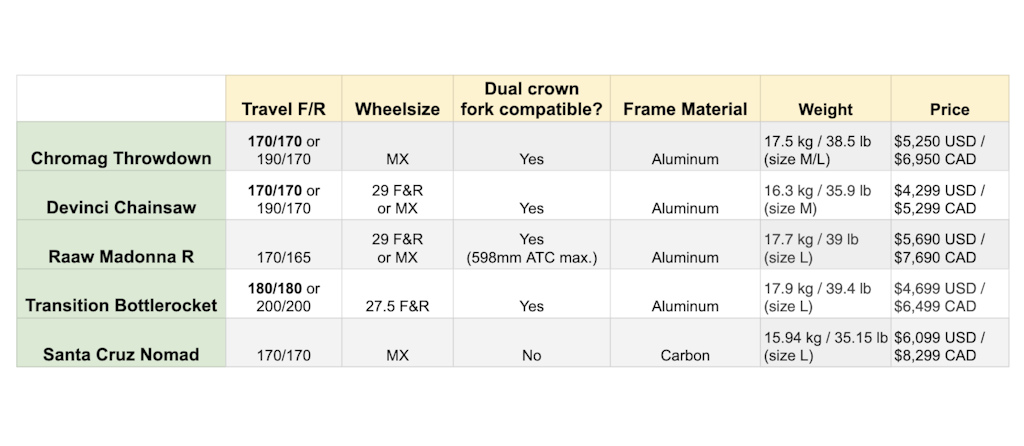
The Throwdown reminds me a lot of the Devinci Chainsaw for two reasons: the geometry and the uphill-to-downhill performance. They're both made from aluminium, can handle 190mm dual-crown forks, and have 170mm of rear wheel travel. One trick that the Chainsaw has over the Throwdown is the ability to carry either a 27.5" or 29" rear wheel.
When it comes to geometry, they're cut from the same cloth with very slack, stretched-out front centres, and they don't really come to life until you pick up the pace or push into very steep terrain.
Pivot placement is what separates them the most, though. The Chainsaw has a high-pivot suspension, which produces a rearward axle path. Even though the static chainstay measurement of the Chainsaw seems short on paper, it lengthens as it settles into the travel. That makes it a hair more balanced at speed, but also slightly harder to pop off the ground. For some riders seeking composure over reactivity, it could be exactly what they're looking for in a freeride bike
Another popular bike that I see in bike parks, that isn't a downhill bike, is the Santa Cruz Nomad. I know it's not aluminium, but the head tube angle and travel numbers are in line with the Throwdown. The carbon construction has pros and cons. On one hand, you get in-frame storage and save weight. The downside is that the Nomad's tubing can't handle a dual-crown fork. It's also less comfortable in the park (though I haven't ridden the Nomad V7 in the bike park). Carbon also makes the Nomad more expensive, which means you'll have to spend $2,000 to get an equal fork and brakes as the Throwdown Eagle 90.
Lastly, the Raaw Madonna R is a close relative of the Throwdown with a utilitarian ethos: an aluminium frame and four-bar, Horst-link suspension design. The Madonna R can hold either rear wheel size thanks to a flip-chip at that lower shock mount. Even with the smaller rear wheel installed, the handling is a world away. Raaw opted for a steeper 64-degree head tube angle, finding stability from a tall stack height and longer chainstay. The result is an even weight distribution across the axles that handles better than the Throwdown at low speed, though the margin for error when blitzing bike park berms is tighter.
Technical Report
Chromag OSX35 25mm rise handlebar: The long and low front centre left me maxing out the stem height on the steer tube. The 25mm rise bar isn't that low, but it's lower than by today's standards. Swapping a handlebar isn't the end of the world, but I'd like to see a 35mm rise as stock equipment, or a longer steer tube - you can always cut it down, if needed.
SRAM Maven B1 Bronze: When SRAM debuted the Mavens, I was proud of them. Finally, a brake that was too strong (for some riders). Although there are ways to tune the power with rotor size, diameter, shape, and pad material, they launched the Maven B1s with a modified lever pivot design and 4 x 18mm pistons per caliper, instead of 2x 18mm pistons and 2x 19.5mm pistons. Chromag chose these for the Throwdown. Metallic pads and 200mm Centerline rotors work just fine for the most part, but I wouldn't have said no to more power. HS2 rotors would quickly boost the power if that's what you need.
Chromag R6 hubs and BA30 V2 rims: The R6 hubs are a newer piece from Chromag. They target faster engagement and longer service intervals. During my time on them, they functioned perfectly, never missing a beat or producing any popping noises. In terms of the hoops, the BA30 V2 rims are seriously strong. I didn't need to touch the spokes once during the review. They shook off any potential dings without a worry.
Pros
+ Extremely comfortable.
+ A confidence-building bike.
+ Good value in Eagle 90 build kit.
Cons
- Geometry may not align with what some riders consider a "park bike".
- Cable routing under the head tube gusset could use some refinement.
Images supplied with this review
Images: MTBSA contributor. Charts retain the currencies and measurements shown in the original.
For South African readers
Overseas prices in this report are not confirmed South African retail prices. Check local availability, warranty support and the complete rand price with your retailer. No MTBSA test score has been assigned.
What's your take?
Share your experience. All comments are reviewed before appearing.
Sign in to join the conversation