
By MTBSA contributor
Find me another bike that uses copy like, "implemented for everything from flat-drop-backflips, to simply lifting your front wheel over a log with ease." That's just one of the many insane tricks that two-time Red Bull Rampage winner Cam Zink has in his back pocket. He's done so on a number of different bikes throughout his career, but two years ago he launched his own brand, Zink Bikes. The Vacay is the short-travel option of the two bikes currently in the line, though both are built exactly to his specifications.
Zink knows a thing or two about jumping, which is why the 150mm-travel Vacay is the meeting point between a slopestyle bike and an enduro bike. It's the short back half of the bike that makes it pop off the geometry page, but the suspension design also lends a hand. The Vacay is full of character that puts playtime above bump compliance and pedalling efficiency.
It's not a total one-sided bike though, as I found out. The steep seat tube has plenty of room to slam a long-travel dropper post, making it more uphill friendly that anticipated. With various fork and rear shock options, the Vacay packs a lot into a little bike.
Contents
MTBSA's Take
| The Vacay doesn't fit in any ordinary bike category, and that's very refreshing to see. It's built to be super responsive for freestyle riders - those who prioritise jumping and playing over all else. With that said, the versatility of this compact fun machine caught me off guard and allowed me to bring a new flavour of riding to trails I'd never pedal to on a slopestyle bike.— MTBSA contributor
Frame Details
Pulling the polished Vacay frame out of the box brought me back to 2005 when I owned a chrome Santa Cruz Bullit. It’s a captivating finish that can easily be brought back to full shine with some elbow grease and polishing tools should it get scuffed up.
The frame weighs 8 pounds / 3.6 kg (w/o shock) and the specifications are as standard as they come. Those include 148mm rear hub spacing, UDH compatibility, a BSA BB, ISCG tabs, and a ZS44/56 head tube. There’s even room for a 200mm dropper on the Regular size frame.
The Vacay can run internal or external cable routing. One important piece needed for keeping the cables from rattling against the inside of the downtube is foam tube insulation. Unfortunately, the external route interferes with the specific Fidlock water bottle mount.
One detail skimped, at least on the frame I received, was the chainstay area. The Vacay arrived without any kind of chainstay protection. I got to work doing arts and crafts with some spare STFU Stay Guard and 3m Mastic tape kicking about. Yes, I know it's backwards. My OCD can't handle the fins pointing forward.
Suspension Design
The Vacay uses “Lift Technology”, which is marketing jargon to explain that the suspension platform and geometry combine to make it incredibly easy to manual and bunnyhop the bike.
The suspension layout itself is a 4-bar, Horst-link design, reminiscent of the Specialized Status and Canyon Spectral. The leverage curve jives with either an air or coil shock, both of which I had the chance to ride. It’s progressive enough to hold up under hard landings, but not too soft off the top that you blow through the travel prematurely.
Outside of the stock 150mm rear wheel travel received from the 230x65mm shock, a shorter-travel, more compact bike setup option is on the table, too, as I’ll get to below.
Horst-Link, UDH compatibility, and a three-way flip-chip.
Geometry
There are few other bikes on the market that stack up to the compact Vacay. The Regular frame, the middle of the three sizes available, has a 476mm reach (high BB). It’s said to fit riders from 5’6” to 6’0”. The Small and Large sizes have reach numbers of 428 and 497mm, respectively. The Small is designed to fit riders from 5’0” to 5’6”, while the Large is best for anyone over 6’0”.
As a start-up brand, I understand adding a fourth frame size adds to investment cost, but three frame sizes to fit everyone is a stretch. The gaps between sizing are huge, although I won’t shout too loud because the Regular fits me perfectly.
From the short 1236mm wheelbase, you can deduce that the rear centre is sawed off. At just 420mm, the Vacay may take the win for having the shortest chainstays of any full-suspension bike on the market. That magic number plays a massive role in the snappiness of the Vacay.
Two flip-chips, one offset, and one centred mount, offer three geometry settings. Those tip the head angle from 65 degrees in the steepest position, down to 63.9 degrees in the slackest, and drop the BB from -23mm down to -37mm. The lowest setting also lengthens the chainstay to 426mm.
This shift also changes the seat tube angle from 79 to 77.8 degrees. One cool point about the seat tube is that the insertion depth is long enough to fit a 200mm dropper on the Regular size.
Specifications
Specifications
Release Date | 2025 |
Price | $7629 |
Travel | 150 |
Rear Shock | RockShox Vivid Ultimate |
Fork | RockShox Lyrik Ultimate 160 mm |
Headset | Chris King InSet 2 |
Cassette | SRAM XX SL |
Crankarms | 5DEV Cam Zink Signature |
Bottom Bracket | SRAM DUB BSA 73mm |
Pedals | Sensus Crue |
Rear Derailleur | SRAM XX SL |
Chain | SRAM XX SL |
Shifter Pods | SRAM Pod Rocker |
Handlebar | Deity CZ40 handlebar |
Stem | Deity Copperhead 42 mm |
Grips | Sensus Lite |
Brakes | Lewis LHP-S4 |
Hubs | Onyx Vesper |
Rim | Stan's Arch/Flow MK4 |
Tyres | Michelin Wild Enduro |
Seat | SDG / Sensus Bel-Air 3 |
Seatpost | SDG Tellis V2 |
Signature build kit listed. Custom build pictured.
Test Bike Setup
As outlined, the Vacay arrived as a frame kit, along with some Sensus Crue pedals and Sensus grips. The rest of the parts were gathered together for their stoutness to form a responsive, yet durable build. That included a Manitou Mezzer at the helm, a Title bar and stem, and SRAM Maven B1 Ultimate brakes. An XTR Di2 medium cage derailleur and Seekrun S7 wireless 170mm dropper post kept the cables to a minimum. For specific jump sessions, I removed the front brake and tried to remember how to bar spin.
I spent the majority of my time in the highest/steepest flip-chip setting. In my mind, this is the most useful and natural position. The slacker settings can be overwhelmed by the slightest rearward shifts in body weight, kicking the fork and front wheel out even further, making understeer a serious concern.
In the right environment, it's possible drop the fork travel to 150mm and install a smaller 27.5” front wheel for an ultra-responsive slalom bike. At the same time, the rear travel can be knocked down to 140mm by installing a 5mm shock stroke spacer, too.
MTBSA contributor
Location: Squamish, BC, Canada
Age: 39
Height: 5'10" / 178 cm
Weight: 170 lb (77.1 kg) / 77 kg
Industry affiliations/sponsors: None
Instagram: @mattb33r
Testing Info
Squamish’s trails are built upon a sprawling network, with many of the feature-filled tracks tucked far away from trailheads and unreachable by shuttle drops, such as Hot Tuna. I appreciated the versatility that the stock configuration offered, letting me pedal to features while still attacking trails with confidence, and left it at that.
I also brought the Vacay up to Grouse Mountain Bike Park, where it thrived on the medium- to large-size jump trails and tighter, natural black diamond trails where it fit right in.
Climbing
As a bike designed for doing backflips off of flat drops, I didn’t expect the Vacay to pedal amazingly well, but I’ve been wrong before. It does a fine job of twiddling along at a relaxed pace on low-angle climbs back up to hit another lap on jump lines.
The steep seat tube angle helps a lot, because you need to keep as much weight forward and away from that very short rear centre as possible. On top of that, the suspension rides firm too. There’s little suspension bob, though that’s not all that makes a bike a decent climber.
Once you point the Vacay off a smooth, graded climb and into more precarious single-track climbs, extra weight shifts are needed to keep the front end down. Likewise, attention to when and where your pedal strokes are placed is a serious requirement.
Would I want to race an enduro on the Vacay? Definitely not. It would be one of my last choices for that style of riding. The suspension is too firm, the back end too short, and the BB too low for throwing pedals in between roots and over rocks. You could get the job done, but it wouldn’t be pretty or easy.
Descending
I’ve described several bikes with short chainstays as “pow snowboards” before, but the Vacay takes that to the next level. The characteristic is reminiscent of floating down a slope as the front end of the board rides high and light, while the rear half takes the brunt of your weight. It makes for extremely reactive handling when it comes time to lift the front end, and it turns on a dime. What these boards give up is stability in choppy or mixed snow conditions.
Much of the same applies to the Vacay. On smoother trails and jump tracks, it’s an absolute blast to ride. Driving energy down through your feet while yanking up on the bars results in instant pop. If you’re coming off of a bike with a longer chainstay, this can happen alarmingly quickly and will take some adjusting to get used to.
When the trail gets rougher, the Vacay performed much better than expected. It’s a stout little unit and the suspension did a decent job of tracking. With it being so easy to move your weight behind the bike, you can plow into objects and not get tossed around, almost like a downhill bike from a decade ago.
The limiting factor for hammering down rough trails is the wheelbase, and that comes into play when it’s time to navigate through corners littered with marbles or filled with brake bumps. The rear wheel sits right underneath you, and that can step out quickly. It also means the front wheel rides lightly and often calls for a forward shift in body weight to find traction. Balancing this fine line is possible, but the Vacay can be a bit skittish at times.
This is a very fun bike, but a particular one indeed. If I had to put a label on it, I’d call it freestyle or mini-freeride. It's the perfect tool for the type of rider that's into building funky gaps, transfer lines, and tree jibs, or a BMXer making the switch over to a mountain bike. 150mm of rear wheel travel isn’t quite enough buffer to tackle massive Utah desert hucks, so for riders wanting to go big, the similarly flavored, but longer travel, Zink Vader would be the ticket.
I found both the Push ElevenSix and the RockShox Super Deluxe to work well on the Vacay. The coil supplied a softer break in to the travel and still shook off hard bottom outs with its firm damping capabilities, as well as the hydraulic bottom out support. Switching to the Super Deluxe air shock lost some sensitivity off the top, but having the option to infinitely adjust the spring rate is useful for the various places you can ride the Vacay.
Technical Report
Push Elevensix coil shock: Howie Zink kindly sent over his Push ElevenSix coil shock for me to test on the Vacay. You can toggle between two separate compression setups by flicking the black lever. That's pretty useful when switching between bike park laps and serious jump line sessions. At $1,300 USD, it's at the top end of the cost spectrum, but Zink Bikes also offers the less expensive Push SV Eight shock, along with three options from RockShox.
Sensus Cure pedals: This was my first ride on the Crue pedals. The size, shape and threaded pins add up to everything you want in a flat pedal. They aren't too dished or overly grippy that you feel totally locked in, yet I never once slipped a pedal.
Seekrun S7 dropper post: For just $231 USD, the S7 post's performance has been excellent. At 930g with the battery installed, it's a chunky unit. The travel maxes out at 170mm, too, but those are small prices to pay to free up the cockpit for spinny bar tricks.
Which Model is the Best Value?
Considering that the Vacay will spend more time in the air than pedalling up climb trails, it seems unwise to spend the extra cash on a fancy drivetrain, which is why the Economical model, or a custom build, would be my pick.
The Economical build offers a SRAM 70 mechanical Transmission drivetrain, a Marzocchi Bomber Z1 fork, and a few of Zink’s other personal component choices. You still get reliable shifting as well as the adjustment of air suspension, which would be useful when switching between jump sessions and trail riding. The only real let-down for anyone riding a chairlift are the SRAM DB8 brakes - they’re not the strongest brakes out there.
With Zink Bikes’ custom parts selector though, you can hop up any of the components with the click of a button. For an extra $367 USD, you could upgrade to the Lewis LHP-S4s and not worry about being under-braked.
How Does It Compare?
One of the few bikes that does come close to the intentions and appearance of the Vacay is the Specialized Status 2 140 (there’s also a 170mm version if you’re looking for more travel). Yes, this bike has less travel, but it too thrives on jump tracks, side hits, and standalone freeride features.
The Status 2 140 uses a two-position flip-chip with less range of adjustment than the Vacay. The Status 2 140 head tube swings between 64.5 and 64 degrees. I preferred the steeper setting of the Vacay and found the slacker position less useful due to its tendency to understeer, even on steep trails. Because of the Status’s limited adjustment range, it’s harder to escape that feeling without inflating the rear shock to feel like a hardtail.
With that said, the Status comes in at a much lower price point - if you can find one, it's currently on sale for $2,000 USD, which is hard to beat in terms of value. The TRP DH-Evo brakes may not be the latest and greatest model in TRP’s line, but they pump out serious power. The Status frame also allows for a regular water bottle cage inside the front triangle.
Pros
+ Incredibly playful and poppy.
+ Frame-only and à la carte component menu offers decent value.
+ More versatile than expected (it isn't a dog to climb).
Cons
- Only three sizes might leave some riders stuck in between frames.
- Middle and slackest flip-chip positions are not very practical.
- Small hiccups with the finished product (head tube reaming, external downtube cable guide/water bottle fitment, and missing chainstay protector).
Images supplied with this review
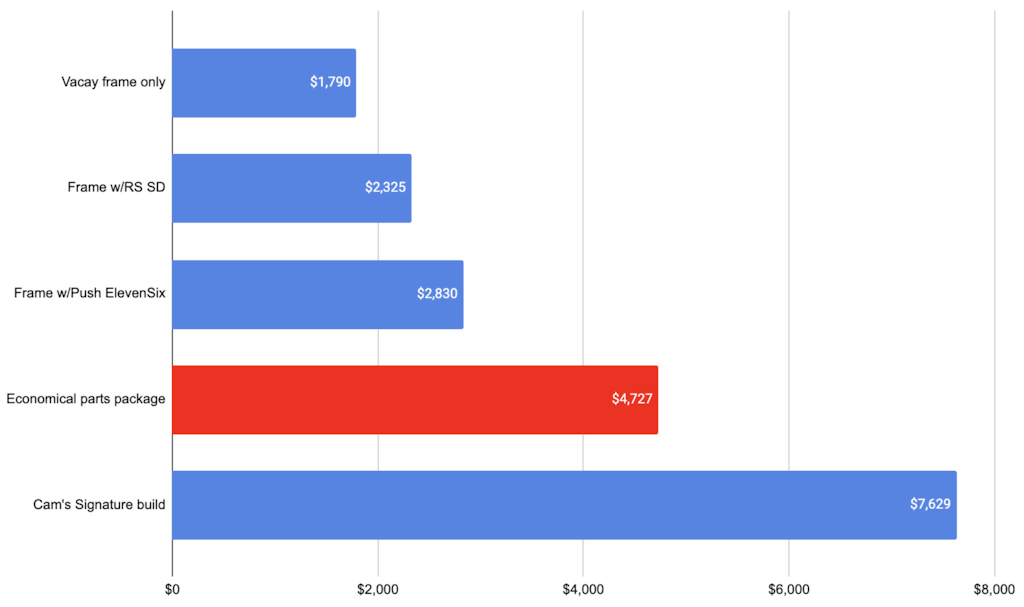
Images: MTBSA contributor. Charts retain the currencies and measurements shown in the original.
For South African readers
Overseas prices in this report are not confirmed South African retail prices. Check local availability, warranty support and the complete rand price with your retailer. No MTBSA test score has been assigned.
What's your take?
Share your experience. All comments are reviewed before appearing.
Sign in to join the conversation