
By MTBSA contributor
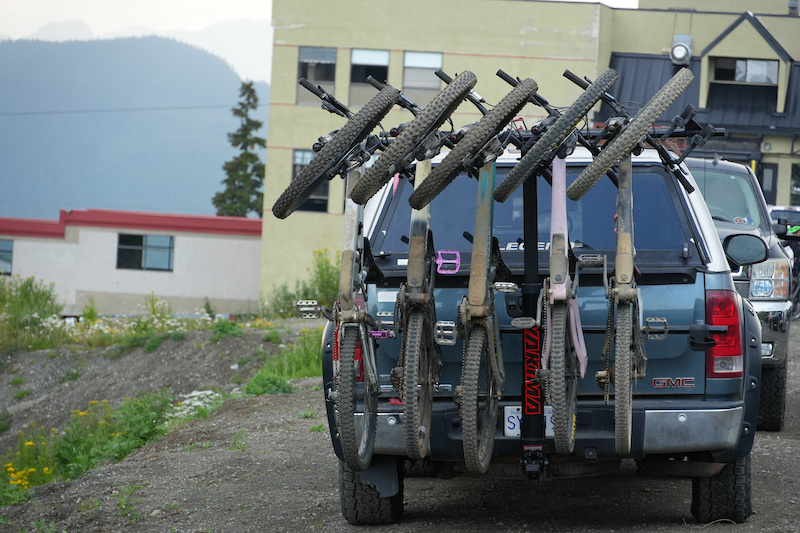
With shuttle season in full swing in the Northern Hemisphere, riders far and wide are loading up their buddies and bikes to head out for some good old-fashioned, gravity-assisted MTB fun. To maximize the experience, riders are optimizing the most time-consuming parts of shuttling, loading, and unloading to allow for less car faff and more ride time. One of the most popular solutions is the vertical bike rack, originally popularized by Canada’s North Shore Racks.
Vertical hitch racks have since taken over the shuttle game. By hanging the bikes upright, the mass stays close to the contact point, meaning less compounding lever action on the hitch. It also means you can easily fit 6, and sometimes even 7 bikes on some rack models, while still having full use of your trunk or truck bed. The bikes don't touch each other's delicate parts, and you can load and unload a full rack in record time.
On the flip side, these racks are heavy, expensive, and not all built the same. As our testing showed, there's a difference between a rack that holds six bikes on paper and one that makes your life easier and keeps your bikes safe when you're smashing as many laps as you can.
We got our hands on three big names in the vertical 6-bike category right now: the Thule ReVert 6, the Velocirax Max 6, and the Yakima HangTight 6. We reached out to a few others, and MTBSA contributor had previously reviewed the ultra-tricked-out and expensive Khyber rack, but for this test, we're sticking to these big three. We ran them through real-world shuttle duty for 5 months and tested them on loading ease, stability, bike-to-bike contact, tilt access, and whether you'd still want to install it on your vehicle solo (spoiler: you most likely don't unless you're into CrossFit). Each rack went through the typical gauntlet, with full loads on bumpy shuttle roads, out in the rain during wet Coastal winters, and everything else that comes with being a shuttle rack.
Here's how it all shook out.
Thule ReVert 6
The Thule Revert officially launched during the 2024 Sea Otter Classic, and now a few years into the category, it's pretty clear they took a lot of care in dialing in the experience.
The main differentiating feature is the Dual TiltAssist Damper, a bidirectional hydraulic system that assists the rack in both directions, not just in lowering. That may not sound like much until you've tried to hoist a fully loaded vertical rack back up after grabbing a refreshment from the trunk, only to find your arm pump is horrendous, and you can barely move your fingers, let alone a 250-pound rack.
Details
• Wheel basket design only contacts rims and tyres
• Per-bike limit: 55 lbs (24.9 kg)
• Total capacity: 250 lbs (113 kg)
• Holds wheel diameters from 20"-29"
• Fits tyres as wide as 3" (5" accesory available)
• Dual-direction tilt-assist damper
• Integrated hitch bike lock to secure your rack to your car
• Weight: 39.6 kg (87.4 lb (39.6 kg))
• Price: $1,299 USD / $1,599 CAD (6-bike)
• More info: thule.com
To use the tilt assist feature on the ReVert, you pull the lever down on the vertical bar; it will gently lower a fully loaded rack of bikes or help pull it back up. Its strong springs do a surprising amount of the heavy lifting, with even a small rider able to easily hoist up a full load on their own without breaking a sweat. It can be a bit tricky to pull an empty rack down for loading because the dampers' spring tension is quite strong. Smaller riders will need to use their full body weight to pull the rack down if it’s completely empty.
Loading is wheel-basket-based: bikes roll in and out without lifting when tilted down, with zero frame or fork contact. The 11-inch spacing between bikes is generous enough that even riders with the widest handlebars won't feel like they're fighting each other (unless their name is Dario). The oversized wheel holders accommodate tyres up to 3" wide and wheelbases up to 53 inches, which covers basically everything on the spectrum barring 32' wheels. They also sell additional fat bike adapters, should you have the desire to shuttle in the middle of winter up north.
The ReVert is available in 4- and 6-bike variants and fits only 2-inch receivers. One less-advertised favourite feature of the ReVert is its easy mounting system, which serves as both a tool-less anti-wobble wedge and a security lock. To install the rack, rather than using a traditional hitch pin, Thule uses a hook pin that flips into the pin hole to secure the rack in place. After the rack depth is set and the pin is inside, a tool-less, wedge-style anti-wobble lever is tightened easily to remove play and lock the rack to the vehicle's frame. The same lever flips into the rack and uses a Thule locking cam to prevent anyone from running away with the whole setup.
The ReVert loses some points in weight capacity. At 55 lbs (24.9 kg) per bike and 250 lbs (113 kg) total, it's limited for heavy e-bikes. You can get a lighter eMTB on here, but it's not a true e-bike rack. For most die-hard shuttle riders, reading about e-bike capacity on your shuttle rack likely makes your blood boil slightly (sorry, but it's worth mentioning). The rack itself also tips the scales at 87.4 lbs (39.6 kg), which means getting it on and off your vehicle without a buddy is possible, but not enjoyable. It’s manageable, but the shape of a bike rack makes it pretty awkward at best.
As with most Thule products, the build quality feels really high-end; the hitch interface is solid, and the AutoAttach system with an integrated hitch lock is clean and easy to use. It feels like the kind of rack you buy once and use for a decade without any hiccups. I want to say that all racks got equal time, and I truly tried, but I do have to admit I may have done a couple of extra missions with the ReVert over the others, thanks to its ease of use.
Pros
+ Easiest rack to use
+ Toolless instalation
+ Dual Tilt Assit feature is super useful
Cons
- More expensive than other options by some margin
- Lower weight capacity than Velocirax
- Tilting an empty rack down will be tricky for smaller riders
Velocirax Max 6
The Max is Velocirax's updated version of their popular original, and the key number here is 100, as in 100 lbs (45.4 kg) per basket. That's nearly double what the Thule allows per slot, meaning you can load this thing with full e-bikes without a second thought. (Sorry to all the e-bike haters.) You can also load a bunch of heavy DH bikes without worrying about the weight limit, too.
For any group that's gone electric, or even partially electric, the Max is in a different weight class than the competition. The 300 lb (136 kg) total capacity across six bikes is the highest in this test, the end result of a structural overhaul that includes redesigned welded hinge bushings, a new centre pin for a more stable vertical lock, and a larger, easier-to-actuate release lever. All of these updates can be felt on the road, too, with the Max providing the most robust, wobble-free experience on test.
Details
• Wheel basket design only contacts rims and tyres
• Per-bike limit: 100 lbs (all slots)
• Total capacity: 300 lbs (136 kg)
• Holds wheel diameters from 20"-29"
• Up to 3" stock / fat basket upgrade available
• Damper-assisted self-lowering (one-way assist / manual lift to return)
• Integrated any rattle wedge, socket
• Weight: 44.5 kg (98 lb (44.5 kg))
• Price: $1,179 USD / $1,394 CAD (6-bike)
• More info: velocirax.com
Similar to the Thule, loading is wheel-basket-based, with no contact with frames or forks. The damper-assisted lowering makes getting bikes on a smooth process, though unlike the Thule, the assist only works one way, when lowering the rack, so you're lifting the loaded rack back up with your own strength. That can become pretty challenging when pushing up a rack full of bikes solo, although I feel like that’s rare in this segment, as you're usually shuttling with pals. I also rarely used the tilt to load, opting rather to load in the full upright position. I used the tilt more to access the trunk/tailgate than anything else. There's also a socket-actuated anti-wobble wedge built into the rack. Adding a socket lets you fit this rack extremely tightly to the car frame. It took top honors for stability on bumpy roads.
Bike spacing is tighter than the ReVert at 10 inches (with a slightly wider 12-inch gap between positions three and four). That's more than workable for most mountain bikes, but riders with wider bars and big pedals may need to be more thoughtful about load order. The Velocirax also skips every other slot for drop-bar road bikes due to handlebar interference, which is worth knowing if you're mixing bike types.
The rack ships with a garage wall bracket included, a nice touch that neither competitor offers in the box. The accessory ecosystem is also the deepest here, with a light bar, SkiRAX attachments, a rolling base, and fat-tyre baskets available to purchase separately.
At 98 lbs (44.5 kg), it's the heaviest rack in the test. That's the trade-off for the highest capacity and the least amount of sway. Getting it onto the receiver solo is doable for bigger riders, but it takes some considerable strength and body English. It's worth calling in a friend for this one, for sure.
Pros
+ Highest weight capacity
+ Most stable rack over rough terrain
+ Best value in terms of performance for the price
+ Large platform of accessories
Cons
- Heaviest rack on test
- Does not have raising assist
- Requires tools to install
Yakima HangTight 6
The HangTight takes a different approach to the vertical rack concept, which makes it both interesting and somewhat complicated to evaluate. While the Thule and Velocirax hang bikes by their wheels, the HangTight cradles bikes by their handlebars. This has some advantages, but not without a few notable drawbacks.
The upside of the handlebar approach on paper is bike versatility. The HangTight handles a wider mix of bike types out of the box than anything else in this test: kids' bikes, mountain bikes, road bikes (up to 4 with drop bars), fat bikes, 32-inchers, and cruisers. If your crew rides everything from 20-inch wheels to early-adopter 32-inch wheels, this is the most accommodating rack. The padded cradles do a good job protecting carbon bars, and the rotating rear wheel cups fit wheelbases up to 50 inches. Personally, I get a little nervous thinking about carbon handlebars taking the brunt of the forces from swaying on a bumpy road, but others may have a higher risk tolerance.
Details
• Handlebar cradle mount design
• Per-bike limit: 70 lbs (centre 2) / 37.5 lbs (outer 4)
• Total capacity: 225 lbs (102 kg)
• Reduced off-road capacity: 135 lbs (61.2 kg)
• Fits pretty well with any wheel size
• Foot-operated Tilt Mechanism
• Threaded antiwobble mounting pin w/ lock, socket
• Weight: 38.4 kg (84.7 lb (38.4 kg))
• Price: $1,099 USD / $1,349 CAD (6-bike)
• More info: yakima.com
There are a couple of major limitations that need to be addressed. First and most glaringly, this rack does not easily accommodate dual-crown forks. Which will likely make it a non-starter for some. You can purchase a HangTight DH Cradle accessory for $89 per cradle if you so choose. Another issue is that the off-road rated weight capacity drops significantly from its on-road rating, "up to 42 lbs (19.1 kg) per bike on the centre two cradles, up to 22.5 lbs (10.2 kg) per bike on outer cradles, making sure not to exceed the total system capacity of 135 lbs (61.2 kg)." So, essentially, you can just barely off-road shuttle with two bikes, assuming your downhill bike weighs under the 42.5 lb (19.3 kg) limit. Last on my list of qualms is that you need a minimum 40mm stem length, with at least 10mm of spacers below the stem. This will likely not be an issue for most riders, but worth mentioning.
The foot-operated tilt mechanism deserves a mention. It's clever and easy to use for rear-vehicle access, but it only works when the bikes are unloaded. I found that out the hard way when I asked my friend Will to 'just quickly tilt the rack down' for a photo, which resulted in him getting violently smashed to the ground. Sorry, Will. The incident also resulted in a broken strap in one of the bike holders. I would love to see a foot-operated pedal, plus the dampers seen on the Velocirax and Thule options, as the hand levers can be a bit awkward to reach. It is worth noting that because the bikes face outwards, it's easier to access the trunk of the vehicle even in the upright position than with the wheel basket systems.
The rack doesn't have an integrated anti-wobble wedge system like our previous two options; instead, the Yakima uses a threaded pin that screws into a block inside the rack. The 15/16 bolt head size was not one I had a socket for, so I had to thread it in with adjustable spanners. In practice, I didn't find this system nearly as stable while driving, with the whole rack exhibiting much more noticeable side-to-side and fore-and-aft sway. I'd recommend a secondary anti-wobble system for riders who do a lot of riding with the Hang Tight.
At $1,049, it's the most affordable of the three and also the lightest at 84.7 lbs (38.4 kg). For families or groups riding lighter bikes across a range of styles, it delivers versatility. However, it is not the rack for a crew of heavy-duty shuttle riders.
Pros
+ Lowest cost rack on test
+ Versatility for a mixed fleet of bikes
+ Easier trunk access while in the upright position
Cons
- Most wobbly rack
- Weight capacity is low
- Awkward to load
- Needs a separate accessory to hold dual crown forks.
Head-to-Head:
Loading & Ease of Use
Winner: Thule
The Thule wins this category by some margin. The bi-directional TiltAssist is in a class of its own for solo operation, and the roll-in wheel baskets mean even a fully loaded rack can be raised and lowered without a friend. The Velocirax's damper-assisted lowering is good, but the lack of an assisted raise means a full load of bikes requires a big oomph. The Yakima's foot-operated tilt is clever, but being functionally unloaded only adds steps to any mid-trip access.
Weight Capacity & e-Bike Compatibility
Winner: Velocirax
Velocirax's 100 lbs (45.4 kg) per basket and 300 lbs (136 kg) total are the highest numbers in the category. It's the only rack here you can (mostly) fully load with six e-bikes without doing math. The Thule's 55 lbs (24.9 kg) per slot is enough for most eMTBs. The Yakima's tiered capacity system (high in the middle, low on the outside) creates loading headaches for heavier bikes.
Road Stability
Winner: Velocirax
All three racks use 2-inch Class III receivers, include anti-rattle features, and perform well on the highway. However, the Velocirax wins this round: its beefy triangulated construction and redesigned centre pin give it the most planted feel on rough pavement and thundered service roads. The Thule was no slouch, but still not quite as dialed as the Velocirax. The Yakima, while decent on smooth roads, showed noticeable movement over even small bumps.
Value Winner
Winner: Velocirax
The Yakima is $79 cheaper than the Velocirax and $200 cheaper than the Thule. However, for serious mountain bikers and anyone with heavy bikes in the quiver, the Thule and Velocirax justify their price tags in ways the HangTight just doesn't match. The Velocirax offers the best overall bang for your buck as a solid, robust rack for the price.
Who Should Buy What
Buy the Thule ReVert 6 if: You want the most refined, solo-friendly vertical bike rack experience. The TiltAssist is a category-leading feature. The clean build, solid hitch interface, and roll-in loading make every shuttle day feel a little more effortless. It's ideal for regular MTB families and crew shuttle setups where most bikes are under 55 lbs (24.9 kg).
Buy the Velocirax Max 6 if: You're hauling e-bikes, you shuttle a lot, and you need a rack that doesn't make you think twice about capacity or stability. The 100 lb (45.4 kg)-per-basket rating provides peace of mind, and the depth of the accessory ecosystem means this can be fine-tuned to fit your needs. It's heavy, but for the right rider, it could be the best tool for the job. (Riders in this category may also want to look into the Kyber rack, but the Max 6 shares many of the same features at almost half the price.)
Buy the Yakima HangTight 6 if: Your crew looks more like a young family or rides a wide variety of lighter bikes (kids' bikes, road bikes, trail bikes), and you want a mix of versatility and value. The handlebar cradle system is unique and offers some advantages for mixed fleets. Just don't expect to haul a heavy quiver of shuttle bikes without doing some math and maybe uttering a few curse words.
Let us know if there are any racks we missed and should check out for future reviews.
Full Detail Comparison
Images supplied with this review
Images: MTBSA contributor. Charts retain the currencies and measurements shown in the original.
For South African readers
Overseas prices in this report are not confirmed South African retail prices. Check local availability, warranty support and the complete rand price with your retailer. No MTBSA test score has been assigned.
What's your take?
Share your experience. All comments are reviewed before appearing.
Sign in to join the conversation