
By MTBSA contributor
With the Transmission family of drivetrain parts, SRAM has set a high bar for the quality of shift one can expect under full pedaling power. It took a couple years, but following the release of their electronic T-Type derailleurs, we finally received a mechanical option with the Eagle 70 and Eagle 90 groups.
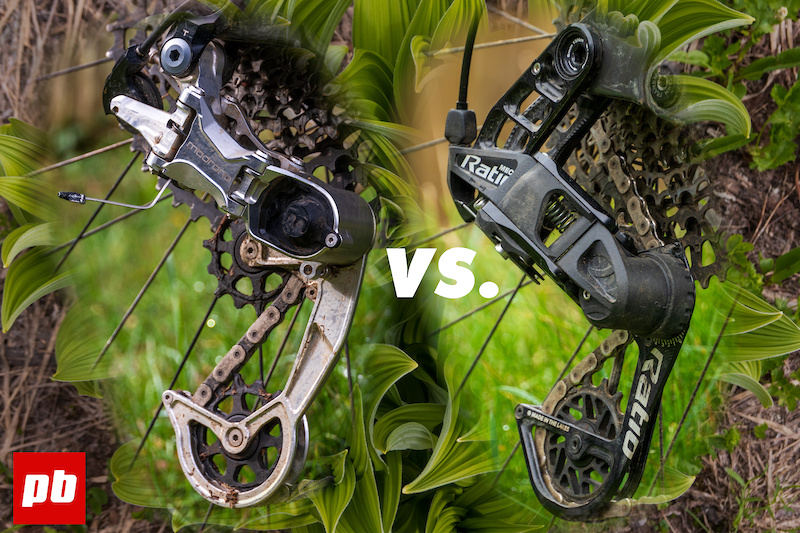
In the meantime, some smaller manufacturers have been hard at work, building their own versions of a cable-actuated Transmission-compatible system. The chief competitors in that space are Ratio and Madrone, and both offer customizable options and setups beyond the constraints of a Transmission-specific setup.
Eagle 90 has quickly become a common sight on lots of stock builds, and the upgrade pathway to higher-cost electronic variants has been established by SRAM. But for folks who want a crisper shift and the reliability of analog parts, there aren't any native options. That leaves the smaller players, with their adaptable systems that can mate up to existing Transmission systems.
In pursuit of that goal, and to see just how durable each of these options really is, I've been riding the Madrone and Ratio derailleurs for months and years. I'll get into how they age, what they bring to the table, and who they might be for.
Option one is the Madrone Jab. The Jab is a convertible derailleur, capable of being configured to suit 11 or 12-speed drivetrains from SRAM or Shimano, with a wide range of compatible shifters as well. There are long and short cage versions, with an optional stiffener plate to keep things sturdier in the event of an impact.
The Jab uses a one-way ratchet clutch, pushing through a 2° deadband before the mechanism engages. You can tune that clutch via a shim stack, with a massive range of adjustment to suit various wants and needs.
Jab Details
• Aluminium construction
• Adjustable ratchet clutch
• Bearing linkage
• 3 cage length options
• 6 shift cam options
• Weight: 326 grams
• Price: $298 USD
• madronecycles.com
Option two is the Ratio Mech. The Mech comes in many flavours, which can be easily selected using their online setup configurator. Made entirely in the UK, the Mech features a mix of aluminium and plastic parts, with a specific body designed to mimic the Transmission derailleur. Unfortunately, given the similarity, that mounting style is no longer being sold as of this past week.
The Mech uses a drag spring to control chain slap, and has a clever cage lock feature to help with wheel removal and setup.
Mech Details
• Aluminium & plastic construction
• Drag spring clutch
• Bearing linkage
• 2 cage length options
• 8 shift fin options
• Weight: 372 grams
• Price: £267 ($364 USD)
• ratiotechnology.com
SETUP
My goal here was to build the best-shifting setup I could, piggybacking on SRAM's Transmission components and improving on their native experience. As mentioned, Eagle 90 is a solid option, but the quality of the shifter does leave some room for improvement. Instead, I opted to use an older 12-speed XX1 shifter, which might just be the nicest feeling mechanical shifter ever made. Out back, a GX T-Type cassette and chain do the job just fine.
With all those other factors in place, the only difference between my two setups is the derailleur itself. I did the majority of testing on my Frameworks Enduro, but both derailleurs also saw time on my Santa Cruz Tallboy and the Carbonwasp Truffle 120 XC bike.
In terms of installation, both derailleurs are fairly easy, but certainly more complicated than simply bolting things to a hanger. Madrone uses a two-part system to stiffen the connection to your frame, with one counter-thread bolt at the UDH hanger, and a standard bolt below. I found that the setup process is a bit slower as a result, but it's a one-time task that requires no upkeep.
The Ratio system had been quite similar to SRAM's one-bolt method, but that similarity might have been what led to their move away from that design. Given their recent move away from that mounting method, they've adopted a similar setup to Madrone, even using the same "T hanger" nomenclature.
Both setups do require a Transmission-specific hanger (provided with sale) to clear the tighter-clearance cassette that the T-Type drivetrain implements. If you end up using the derailleur for a different setup, it's quite easy to swap things out for a standard hanger.
SPEED
One of the chief complaints people have about the wireless Transmission systems is how methodically it shifts through the gear range, with notable pauses between steps when compared to a cable-actuated setup. Eagle 90 improves on this, as there is no latency in a cable, but the shifter is limited to a couple cogs at a time. Shimano's cable-actuated kits feel quicker, and my goal was to match that experience with the aftermarket setups here.
In short, both the Madrone and Ratio can run through the 12-speed cassette quicker than the stock setup, ripping up as many gears as you'd like with a quick swipe of the shifter. This is somewhat dependent on what shifter you choose to run, but in general neither is going to hold you back.
Clutch force does affect how easy it is to perform multiple shifts at once, and here I'd give a nod to the Ratio Mech. The drag spring has lower action force than the Madrone's clutch, and the cage spring designs have slightly different tension to them - as a result there's less resistance when moving up the cassette. I never found myself struggling to shift, but if you're sensitive to the action force, then it's worth considering.
ACCURACY
Unlike SRAM's T-Type systems, both the Madrone and Ratio use traditional b-gap and limit screws to dial in your shifting parameters. Both take a bit of time to perfect, with b-gap having a significant effect on how well your drivetrain shifts through the range. The setup guides published by both brands lay out exactly how to get this perfected, with the limit screws following the same procedures you'd utilize on any drivetrain.
In rough moments on trail, the Madrone Jab felt like it did a better job of keeping the drivetrain in line, with fewer missed shifts and gear hopping. The Mech holds its own against Eagle 90, but had more chain flail and resultant slop when compared to a Jab with the clutch tension turned up.
Both the Jab and the Mech have well-designed cage springs that keep the derailleur returning to the harder gears in the cassette with ease. I never had issues getting the drivetrain to drop down into the smaller cogs, even in challenging grimy conditions. Madrone's design does use two springs mounted in tandem, so you can expect a return force when shifting down the cassette.
It's worth noting that those looking for digital precision in a Transmission setup will probably still be best served by, well, digital Transmission. The wireless AXS stuff is hard to beat when it comes to metering out perfectly-spaced shifts, as any cable drivetrain has the inherent element of a human operator, no matter how crispy those shift levers feel.
STABILITY
This is the biggest differentiating area between the Madrone and Ratio derailleurs. The Jab has an adjustable ratchet clutch, that can be brought up to impressively high tension if you really want to reduce chain flail.
The Mech is more in line with the stock Eagle 90 setup, with enough stability to keep the chain on, but a decent bit of flail and noise on rough sections of trail. Madrone's clutch does break in, so you'll have to tighten things back up after a preliminary ride-in period, but after that I've found the performance to be very consistent.
Whether this matters to you is ultimately a personal decision, but having run through a few adjustment options on the Jab, I found myself preferring the most stable (strongest clutch force) setup in just about every situation.
One use case where the Ratio's drag spring might be preferable is on bikes with very close chainstay to chain clearance. The ratchet clutch that Madrone is currently implementing has a 2° deadband before kicking in, so the chain can move freely in that small band of travel. As a result, bikes with limited clearance can have the chain tick against the stay, causing a fair bit of noise. Across a few bikes I've tried the Jab on, this was only an issue on the Truffle 120, which also had fairly minimal mastic tape chainslap protection at the time. Again, perhaps a niche complaint, but that's why we're here.
CONCLUSION
These are both premium options, offering an excellent shifting experience in a completely rebuildable package. But so does Eagle 90, so why would you opt to upgrade to one of the aftermarket options? For starters, the ability to mate the derailleurs with whatever shifter you please is a huge plus, and opens up the potential for some very interesting mix-and-match builds.
The second feather in the caps of the Jab and the Mech is their use of bearings throughout the parallelogram, which keeps the derailleur moving very smoothly through season after season of grit and grime. If and when those foul up, you can lube or replace them, adding yet another level to the serviceability.
Lastly, the reconfigurable nature of these two options will keep them relevant for whatever you might end up running down the line. Want to move away from this Transmission setup to a Shimano Linkglide option? No problem. Feeling strong, and want to save weight? 11-speed options exist for both, with shorter cages to boot. I like the open-ended nature of these, as you're not locked into one brand's most current catalogue.
As to what I would choose, it depends a bit on the bike in question. For long-travel builds like my Frameworks, I'd opt for the Madrone Jab. The clutch tension keeps things quiet and stable, and the derailleur's construction and mounting method has proved robust through a ton of riding.
For a shorter-travel bike like the Tallboy, I'd pick the Ratio Mech. Clutch tension still matters there, but having a light-action shift that feels easy in every gear is a nice feature, and might matter to those who are XC racing or who simply like that feel. Given the recent change in Ratio's ability to offer a direct-mount option, I can't say how things compare, but hopefully that performance carries across.
Madrone Jab Pros
+ Best clutch for hard riding
+ Widest range of aftermarket setup options
+ Impressive combination of durability and weight
Madrone Jab Cons
- Deadband in clutch can cause noise on some bikes
- Heavier shift force than competition
Ratio Mech Pros
+ Quick and light shift feel
+ Wide range of setup options
+ Durable, despite plastic components
Ratio Mech Cons
- No more direct-mount option
- Clutch could be stronger
Images supplied with this review
Images: MTBSA contributor. Charts retain the currencies and measurements shown in the original.
For South African readers
Overseas prices in this report are not confirmed South African retail prices. Check local availability, warranty support and the complete rand price with your retailer. No MTBSA test score has been assigned.
What's your take?
Share your experience. All comments are reviewed before appearing.
Sign in to join the conversation