
By MTBSA contributor
Clip In Where You Fit In
At the moment there are two main camps when it comes to clipless pedals - you’re either on an SPD-style pedal, or on Crankbrothers. Historically, Shimano has been the top contender when it comes to SPD pedals - after all, it’s their design, and they’ve been doing a very good of job perfecting it over the years, even after the original patent expired. Speaking of patents, the it looks like the Crankbrothers patent has expired as well - I’m curious if we’ll see any newcomers hit the market that use the 4-sided egg beater mechanism.
For this round-up, I’ve been putting the miles in on 5 of the newest SPD-compatible entrants into this segment of the market. All of the pedals have a medium to extra-large sized platform, and they’re aimed at riders looking for more support than a tiny cross-country pedal typically delivers, whether that’s for trail riding or DH laps.
Aren’t They All the Same?
As it turns out, no. While the clip-in mechanisms on all these pedals look very similar, subtle differences do have a noticeable influence on how easy (or hard) it is to get in or out. As you’ll see in each section, some pedals were a little reluctant to release, while others were buttery smooth right out of the box. The maximum amount of spring tension varies as well, something to consider for riders who want to reduce their chances of inadvertently clipping out. I typically run my pedals 1/4 - 1/2 of the way through the tension range, but every rider is different.
It's important to take the time to ensure that the pedals you end up with work well with your shoes; in some cases that will involve installing a small plastic spacer between the cleat and shoe sole. That may seem obvious, but all too often riders forget to check for the proper amount of shoe / pedal clearance and run into trouble getting in or out of the pedals. That advice goes for installing pins too - the rearmost pins can make it difficult to clip out if they dig too far into a shoe's sole. In the words of Ice Cube, "check yo' self before you wreck yo' self.”
Etymology
Any time there's a clipless pedal review someone in the comments inevitably raises their virtual hand to point out that the term "clipless" is confusing. After all, don't you clip into this style of pedal? You sure do, but that's not where the word "clipless" comes from.
For those of us who began riding in the olden days, there was a time when toe clips and straps were fairly common, those sketchy things that you stuck your feet into and then pulled on a cam strap to tighten down. Clips and straps thankfully went away for mountain biking, replaced by pedals that no longer had toe clips. Hence, the term clipless pedals.
I like to think of it as a nod to mountain biking's past, rather than getting annoyed by the term, but that's just me. I realise that many, many riders have never experienced the frightening experience of riding with toe clips and straps, which is why it's totally fine to call these pedals "clips," "click-in pedals," "clip-in pedals," or some other similarly descriptive term.
OneUp Clip
• Internals: 3 bearings, bushing
• 95 x 80 x 14.5mm
• Weight: 406 grams
• Price: $160 USD
• oneupcomponents.com
OneUp had a slightly rocky start when they first launched their Clip pedals, but those early issues were quickly resolved, and clipping in and out is now uneventful, just the way it should be.
It’s the pedal-to-shoe interface that really sets these apart from the rest - the height of the clip-in mechanism and the surrounding platform provides a very good spot to stand on, reducing the metal-on-metal floating feeling that can happen with some shoe / pedal combinations. There’s still the usual amount of float (5 degrees, with a 12-degree release angle), and clipping in and out is as easy as you’d like, but once you’re clipped in the pedals feel very secure.
They don’t offer the absolute highest possible tension out of all the pedals in this roundup, but they do have one of the smoothest exit feels when the tension is turned up all the way. Wolftooth and Renthal offer a higher maximum tension, but the release doesn’t feel quite as smooth.
Pros
+ Very secure when clipped-in
+ Excellent entry / exit feel
+ Light weight (for this type of pedal)
Cons
- May require extra setup time to ensure proper cleat / shoe clearance
Tenet Osiris
• Internals: three bearings, bushing
• 110 x 82 x 21mm
• Weight: 544 grams
• Price: $159 USD
• ridetenet.com
The Osiris is Tenet’s first clipless pedal, and they went all out to ensure it was tough enough to withstand just about anything. It’s EFBE Tri-Test Ebike-Gravity certified, and it comes with a lifetime warranty. That’s on top of one free pedal refresh with in the first year, and free bushings and bearings for life.
All of those details sweeten the pot, but there are a couple things holding the Osiris pedals back. If weight’s a concern this isn’t the place to look - they’re pretty chunky, and are around 100 grams more than the options from OneUp, Shimano, or WolfTooth.
The bigger drawback is the lack of consistency when unclipping. Clipping wasn't an issue, but I had trouble clipping out, typically at slower speeds with my heel pointed slightly downwards. That’s a common scenario, one that comes up if you need to dab to get around a tricky uphill corner, or even when unclipping and putting your foot back on the ground at the end of a trail. The cleat would hang up sometimes, making it difficult to get out, and I tipped over more than once. Luckily I was alone, because I let loose some very bad words - there’s nothing more frustrating than being unable to release from a set of pedals.
I tried different shoes, different cleats, different spring tensions, but no matter what I did I wasn’t able to achieve the same level of release consistency that the other top pedals in this category offer.
Pros
+ EFBE Tri-Test Ebike-Gravity Certified
+ Free bushings and bearings for life
+ Lifetime warranty
Cons
- Inconsistent release
- Heavy
- Lowest maximum tension out of all the pedals in this roundup
Shimano XTR Enduro M9220
• Internals: cup and cone bearings
• 99 x 79 x 18
• Weight: 448 grams
• Price: $260 USD
• shimano.com
My main takeaway after testing all these pedals is further confirmation that Shimano has their clip-in mechanism completely dialed. You wouldn’t think there’d be much difference, and at a glance the mechanisms on all of these pedals look really similar, but there’s something about Shimano’s design that’s just a bit smoother and more intuitive compared to the rest. OneUp and WolfTooth come the closest, but there’s something a little extra-slippery about the XTR Trail pedals that makes getting in and out a breeze.
All of the pedals on this list are pretty easy to service, but Shimano gets a point for their cup and cone design. Once you’re familiar with the basics it’s simple to keep these pedals running for season after season without needing to purchase any additional parts.
The platform itself is well designed, and the ridges on each side to help add a little extra traction when things are slippery. The body of the Wolf Tooth pedals has a similar feature, but the ridges aren’t as tall, and aren’t as grippy when they’re coated in slimy mud.
Shimano’s new CL-MT001 cleats also deserve a shout out. They'll work with any SPD pedal (including all the ones on this list), and allow for more of a straight up and down entry, as opposed to the traditional toe-first method that’s required with the typical SPD cleat.
Pros
+ Super smooth entry and exit
+ Cup and cone design for easy servicing and longevity
+ Included CL-MT001 cleats are a nice upgrade over the SH51 cleats
Cons
- Expensive (Shimano recently released the XT version that's $160)
Wolf Tooth Shift
• Internals: 3 bearings, bushing
• 96 x 79 x 15mm
• Weight: 412 grams
• Price: $239.95 USD
• wolftoothcomponents.com
Wolf Tooth is a relative newcomer to the clipless pedal world, but the Minnesota-based company didn’t waste any time in releasing a complete lineup that covers everyone from gravel to DH riders. The Shift pedals have the widest platform of that bunch, with a generous amount of real estate on each side of the clip-in mechanism to provide extra support during hard landings or on rough trails. The dimensions are pretty similar to the OneUp Clips, and the weights are close too.
The Shifts do offer slightly higher maximum release tension than the OneUp or Shimano pedals, which could be a plus for riders that struggle with blowing their feet out at inopportune moments. The Q-factor (the distance the pedal sits from the crankarm) can also be easily adjusted by swapping the orientation of the internal spacers. They ship with a 55mm Q-factor, which can be changed to 51 or 59mm.
On the trail, the Shift pedals were trouble free. I found the entry/exit action of the Shimano and OneUp pedals to be ever-so-slightly smoother, but it’s very close - I don’t have any complaints about the feel of the Shifts. They’re also fully user serviceable, and Wolf Tooth offers a full range of replacement parts, minimizing the chances that the pedals couldn’t be restored to like-new condition even after years of abuse.
Pros
+ Light and thin with a good platform size
+ Adjustable Q-factor
+ Fully user serviceable
Cons
- On the higher end of the price scale
Renthal DHC
• Internals: 3 bearings, bushing
• 104 x 110mm x 118mm
• Weight: 616 grams
• Price: $226.20 USD
• renthal.com
The DHC pedals are something of an outlier in this roundup, but I wanted to include them since they’re so different from the norm. It’s the platform’s dimensions that sets them apart - they’re essentially a full-size flat pedal with a clip in mechanism build in. That mechanism is in the same place it would be on most clipless pedals, which makes the pedals look a little odd at first, since the mechanism is sits so far inboard from the rest of the pedal.
On the trail I didn’t have any issues clipping in and out - I tend to use the crank arm as a guide for my foot, so even though there’s all that extra platform I rarely had any clip-in misses. The downside of the platform is the ground clearance, or the lack thereof. The pedal isn’t that thick, but I did have more rock / root strikes than usual, typically on the outboard portion of the pedal. It was as if my mind had trouble coming to terms that there was a fully size platform to contend with even though I was clipped int. Rock strikes are always user error, but it’s worth mentioning that this design could make them more common.
The pedals feel very secure and solid underfoot, especially when using slightly softer shoes, and they do provide a massive target to aim for after unclipping. The maximum releases tension is the highest out of all the pedals tested here, which makes sense considering the DHC's downhill-oriented intentions.
Pros
+ Very wide range of release tensions
+ Massive target to aim for after unclipping
Cons
- Larger platform increases chances of hitting things
- That extra size comes with extra weight.
Thoughts on Pins
Whether or not a clipless pedal has traction pins has become a selling feature, but even after testing all these pedals I’m still not convinced it’s necessary. If anything, I found the pins to be a hindrance when clipping out, at least not until they were lowered enough be be virtually ineffective. Yes, they might help a little with grip when hunting for the pedal after taking a foot off, but I think the ridges or chamfers around the clip-in mechanism are a better solution, or there’s something like Renthal’s supersized platform that’s very hard to miss.
Durability
I didn't have any unexpected durability issues with any of the pedals, which isn't quite as interesting to report, but it's good news for potential buyers. It's not that surprising, either, since all of the pedals are running a fairly similar internal layout, with the exception of Shimano's time-tested cup and cone layout. If you do notice a change in performance, adding a couple drop of lubes or light grease to each spring is typically all it takes to return things back to normal.
Maximum release tension rankings
1. Renthal DHC
2. Wolftooth Shift
3. OneUp Clip
4. Shimano M9220
5. Tenet Osiris
Ease of entry / exit rankings
1. Shimano M9220
2. OneUp Clip
3. Wolf Tooth Shift
4. Renthal DHC
5. Tenet Osiris
Editor's Choice
| Which pedal would I buy with my own money? Factoring in price, weight, and performance, it's OneUp's Clip pedals that get my vote, with Shimano's XTR Enduro (well, I'd go with XT and save some cash) pedals coming in a very close second. Shimano's pedals are a little smoother to get in and out of, and OneUp's have an almost "springy" feel when they release, but neither pedal let me down. OneUp's design positions the pedal a little closer to the shoe, which creates a very secure interface, almost like the shoe and pedal are one cohesive unit.— MTBSA contributor
Images supplied with this review
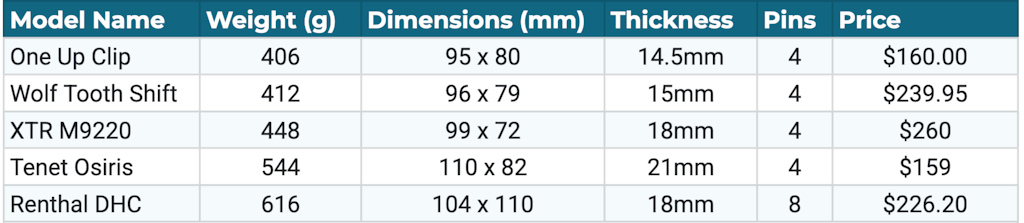
Images: MTBSA contributor. Charts retain the currencies and measurements shown in the original.
For South African readers
Overseas prices in this report are not confirmed South African retail prices. Check local availability, warranty support and the complete rand price with your retailer. No MTBSA test score has been assigned.
What's your take?
Share your experience. All comments are reviewed before appearing.
Sign in to join the conversation